
- Slash Total Cost of Ownership: Achieve up to 50% lower TCO and 20% lower CapEx compared to traditional OEM solutions.
- Maximize Resource Utilization: Leverage the Nous Controller and Liqid orchestration to dynamically pool and allocate GPUs (NVIDIA, Intel, AMD) via PCIe/CXL, eliminating costly over-provisioning.
- Scale with Confidence: Deploy pre-validated Scale-Up and Scale-Out architectures designed specifically for memory-bound inference workloads and Agentic AI.
- Download
- Download 203
- File Size 926 KB
- The Financial Breakdown: A detailed cost model showing how disaggregated networking reduces CapEx and OpEx, with a typical payback period of just 18 months.
- AI Infrastructure Strategy: Why market trends indicate Ethernet is outpacing InfiniBand for AI workloads due to cost efficiency and supply diversity.
- Sensitivity Analysis: Proof that Whitebox solutions maintain a ≥45% cost advantage even under aggressive proprietary discounting scenarios.
- Download
- Download 101
- File Size 757 KB
- Architectural Advantages: How SONiC’s modular design and control plane separation significantly reduce attack surfaces.
- Hardware Acceleration: The power of leveraging commercial ASICs for high-speed encryption, DDoS mitigation, and ACL enforcement directly in hardware.
- Open-Source Transparency: Why community-driven code auditing offers faster vulnerability response and "many eyes" vigilance compared to closed vendor ecosystems.
- Strategic Best Practices: Actionable guidance on implementing secure boot, automation, and supply chain integrity in a multi-vendor environment.
- Download
- Download 178
- File Size 340 KB
- Beyond the Specs: Why PCB quality, power architecture, and mechanical resilience matter more than the datasheet implies.
- The TCO Trap: How "bargain" devices inflate Total Cost of Ownership through higher failure rates and remediation costs.
- Manufacturing Maturity: The crucial role of supply chain stability and automated testing in guaranteeing 24/7 reliability.
- Download
- Download 127
- File Size 351 KB
- The RoCEv2 Advantage: Why RoCEv2 offers a more scalable, cost-effective alternative to InfiniBand without sacrificing routability or performance.
- Achieving Lossless Ethernet: A deep dive into configuring Priority Flow Control (PFC) to prevent packet loss during bursts.
- Congestion Management: How to implement Explicit Congestion Notification (ECN) alongside PFC to dynamically throttle transmission speeds before bottlenecks occur.
- Download
- Download 503
- File Size 381 KB
- Unified Manageability: Streamline operations with a framework that supports industry-standard CLI, REST, and gNMI APIs.
- Deep Visibility: Utilize advanced silicon-driven telemetry, including Buffer Statistics Tracking (BST) and Inband Flow Analyzer (IFA).
- Comprehensive Automation: Accelerate deployment with Zero Touch Provisioning (ZTP) and native support for Ansible and Chef playbooks.
- Flexible Licensing: Explore tailored software packages—from Cloud Base to Campus—designed to fit specific architectural needs.
- Download
- Download 638
- File Size 894 KB
- Architectural Shifts: Understand the structural differences between Traditional Enterprise Networks (Access/Aggregation/Core) and Data Center Leaf-and-Spine topologies.
- Overlay & Underlay: Clearly define the relationship between the physical backbone (Underlay) and virtualized tunnels (Overlay) using protocols like VXLAN.
- EVPN Deep Dive: Demystify Ethernet Virtual Private Networks, including Route Types (RT-1 to RT-5), Designated Forwarder (DF) election, and Aliasing.
- High Availability: Learn how Multi-Chassis Link Aggregation (MC-LAG) evolves standard LAG to provide redundancy across independent chassis.
- Download
- Download 96
- File Size 894 KB
Is your enterprise AI strategy stalled by infrastructure complexity?
While the promise of open infrastructure offers unparalleled innovation and flexibility, the reality of integrating disaggregated components often leads to operational gridlock. Enterprises are stuck balancing the need for speed against the risks of vendor lock-in and spiraling costs.
Introducing Nexvec™, a turnkey open infrastructure solution purpose-built for the next generation of Enterprise AI. This whitepaper details how Nexvec™ bridges the gap between complex open components and a seamless, "out-of-the-box" user experience. By integrating disaggregated open networking (SONiC), composable computing, and storage into a single architectural stack, Nexvec™ allows you to focus on business outcomes rather than integration headaches.
Inside this report, you will learn how to:
Download the guide to discover how to operationalize AI from Day 0 to Day 2 with the freedom of open standards and the simplicity of a turnkey solution.
Stop Paying the "Vendor Lock-in" Tax on Your Network Infrastructure.
As enterprises migrate toward GPU-centric architectures to support AI and machine learning, the cost of traditional, proprietary networking is becoming a barrier to innovation. Is your budget consumed by inflated hardware costs and recurring licensing fees?
This executive whitepaper, "The Business Value of Adopting a Whitebox Switching Strategy," provides a rigorous 5-year Total Cost of Ownership (TCO) analysis comparing proprietary solutions against open Whitebox switching. The findings are clear: adopting a Whitebox strategy with an open Network Operating System (NOS) can yield a 54% reduction in TCO.
Inside this report, you will discover:
Don't let legacy infrastructure drain your resources. Download the full study to see the numbers behind the shift to open networking and learn how to build a future-proof, high-performance data center fabric.
Is your network security relying on the opaque promises of a proprietary "black box"?
In the era of cloud-native applications and AI-driven workloads, relying on perimeter defenses alone is no longer sufficient. This comprehensive whitepaper, "Whitebox Switching and Security," reveals how SONiC (Software for Open Networking in the Cloud) is redefining the security landscape by transforming it from a hidden feature into a transparent, auditable, and community-driven process.
Deploying SONiC on commercial ASIC-based Whitebox switches offers more than just cost savings; it provides a robust foundation for a Zero Trust architecture. Unlike traditional systems, SONiC’s disaggregated nature allows for granular control, enabling you to enforce software-defined security policies at line rate without compromising performance.
Inside this report, you will discover:
Don’t leave your infrastructure secure by chance; secure it by design. Download the full guide to master the integration of open networking and advanced security.
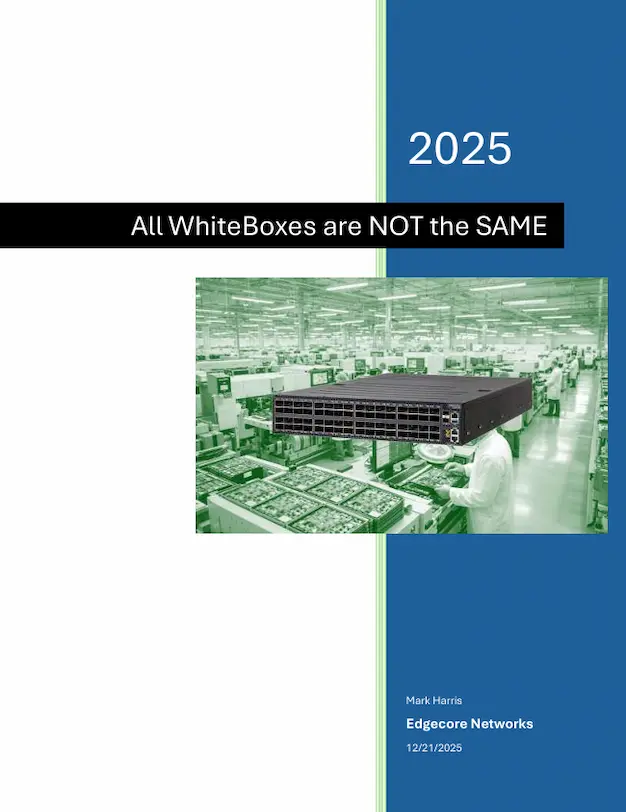
Is your network strategy built on a dangerous myth?
In the world of disaggregated networking, a common misconception persists: if two switches use the same high-performance silicon, they offer identical results. This whitepaper, "All WhiteBoxes are NOT the SAME," shatters that assumption by revealing the critical engineering realities that separate premium infrastructure from low-cost commodities.
While the ASIC acts as the engine, the chassis determines the vehicle's survival. Low-cost manufacturers often achieve aggressive price points through invisible compromises—using inefficient power supplies, inferior capacitors, and ignoring essential thermal simulations. These deficiencies typically lie dormant until deployment, where they manifest as signal integrity issues, premature component aging, and costly unplanned downtime.
This comprehensive guide explores:
Don’t let hidden hardware deficiencies undermine your data center. Download the full report to understand the fit-and-function engineering details that secure long-term operational resilience.
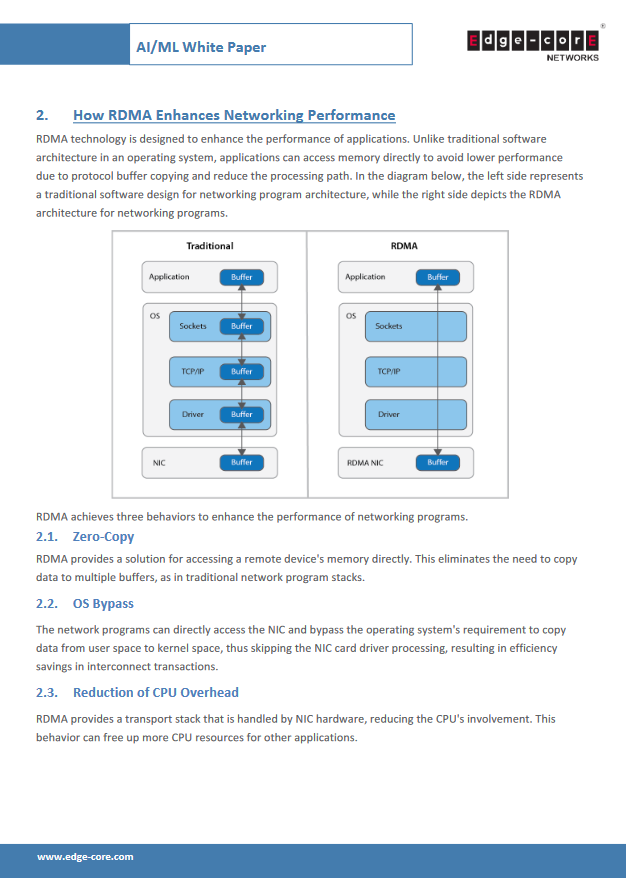
Is your network the bottleneck in your AI/ML cluster?
As data centers rapidly scale to accommodate distributed neural networks, traditional networking architectures often fail to meet the rigorous demands of "elephant flows" and parallel computing. The difference between a stalled training job and a successful deployment often lies in the efficiency of your transport protocol.
This technical whitepaper, "AI/ML Networking Background," provides a comprehensive guide to optimizing high-performance computing environments using RDMA over Converged Ethernet (RoCEv2). Unlike traditional TCP/IP stacks that burden the CPU with excessive buffer copying, RDMA technology leverages "Zero-Copy" and "OS Bypass" capabilities to allow direct memory access, significantly reducing latency and CPU overhead.
Inside, you will discover:
Download the full report to learn how to tune your network for the high throughput and low latency required by modern AI workloads.
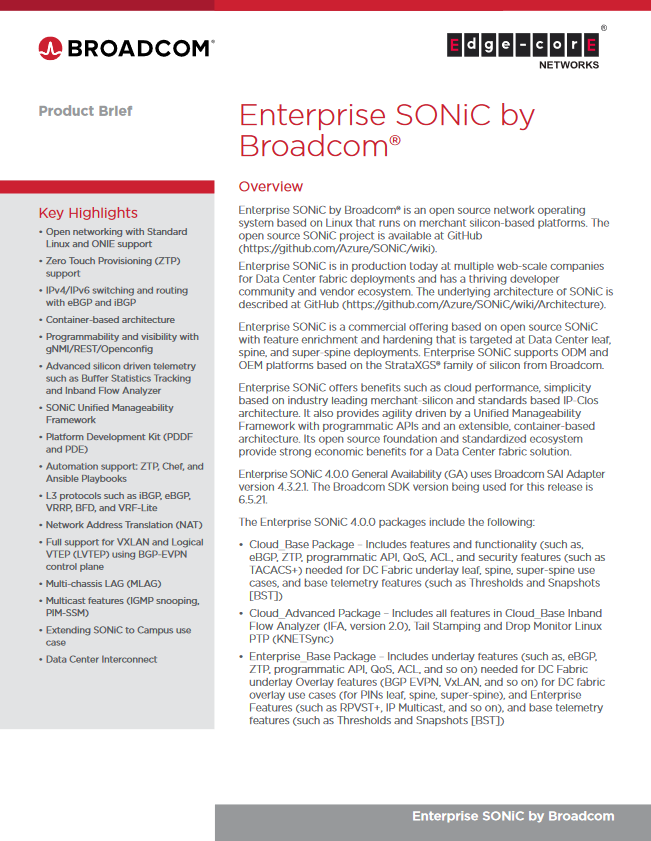
Unlock the agility of hyperscale networking for your enterprise.
Enterprise SONiC by Broadcom® bridges the gap between open-source innovation and carrier-grade reliability. Built on a hardened version of the community-driven SONiC project, this commercial offering leverages the power of StrataXGS merchant silicon to deliver a container-based, fully programmable network architecture.
As organizations move away from proprietary black boxes, Enterprise SONiC provides a standardized Linux-based foundation that scales from Data Center spines down to the Campus edge. Whether you are deploying a standard Layer 3 CLOS fabric, a complex VXLAN/EVPN overlay, or a Data Center Interconnect (DCI), this solution ensures consistency across your entire infrastructure.
Key features detailed in this product brief include:
Download the full product brief to discover how Enterprise SONiC can modernize your network operations and reduce total cost of ownership.
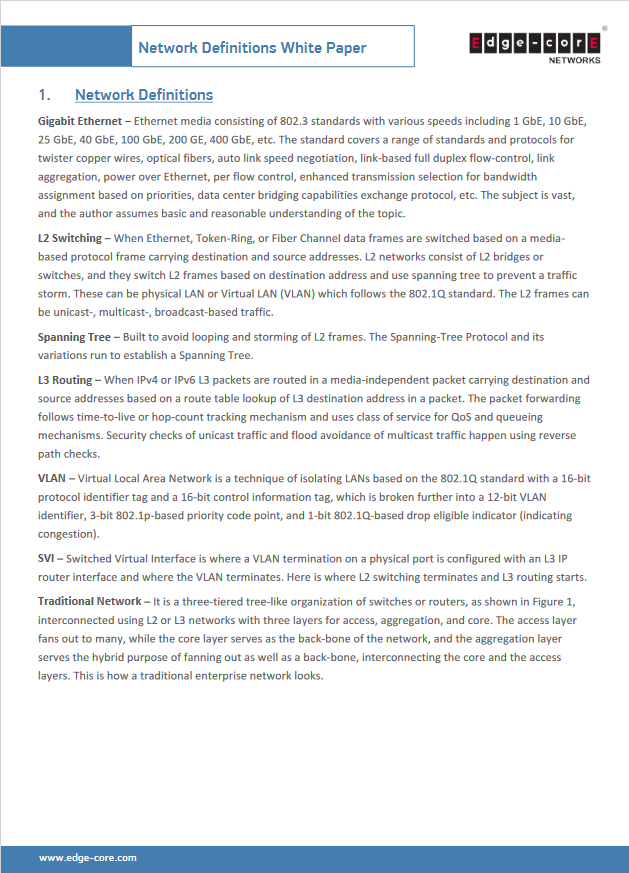
Are you fluent in the language of modern data center networking?
As network infrastructures evolve from traditional three-tier hierarchies to agile Leaf-and-Spine architectures, the terminology defining these systems has become increasingly complex. Whether you are a network engineer, architect, or IT manager, bridging the gap between legacy definitions and next-generation protocols is essential for deployment success.
This comprehensive whitepaper, "Network Definitions," serves as an authoritative glossary and technical guide. It moves beyond basic definitions of Gigabit Ethernet and VLANs to explore the advanced mechanisms that power today's scalable fabrics.
Key topics covered include:
Download this guide to master the vocabulary of EVPN-VXLAN, BGP, and routing protocols, ensuring you have the technical clarity needed for your next infrastructure project.