What is AI Networking?
AI networking refers to the high-performance network infrastructure required to support large-scale artificial intelligence and machine learning workloads. Unlike traditional enterprise applications, AI workloads are highly network-intensive because they depend on massive volumes of data moving continuously between compute, storage, and accelerator resources.
Modern AI training environments generate significant east-west traffic—server-to-server communication within the data center—rather than the north-south traffic typical of conventional applications. During distributed training, thousands of GPUs frequently exchange model parameters, gradients, and intermediate data to remain synchronized, making efficient GPU cluster networking essential for performance at scale.
As AI clusters grow from dozens to thousands of accelerators, network performance becomes critical. High-capacity switching powered by merchant silicon AI switches, including 400G and 800G Ethernet platforms, helps reduce bottlenecks and sustain throughput for large-scale AI workloads.

This process relies heavily on fast GPU synchronization and collective communication operations such as all-reduce. Even small amounts of latency, congestion, or packet loss can leave expensive GPUs idle, slowing model training and reducing infrastructure efficiency.
To support these demands, modern AI networks rely on low-latency, high-bandwidth fabrics designed to maximize GPU utilization and move data efficiently across the cluster. Supporting resources such as the 人工智慧/機器學習白皮書, Edgecore Open Fabric以及 Broadcom Tomahawk 6 provide deeper technical context on large-scale AI fabric design.
Why AI Workloads Break Traditional Data Center Networks
AI workloads place fundamentally different demands on network infrastructure than traditional enterprise applications. As AI clusters scale, conventional architectures often become bottlenecks, limiting performance and extending training times.
A major challenge comes from intensive GPU collective communication patterns such as all-reduce, where large volumes of data must be exchanged across many GPUs during every training iteration. These operations require extremely fast, predictable communication to keep distributed workloads synchronized.
AI workloads also generate short but intense traffic bursts known as microbursts, which can overwhelm traditional Ethernet fabrics and cause congestion, packet drops, and retransmissions. Even brief interruptions can stall GPU pipelines and significantly reduce cluster efficiency.
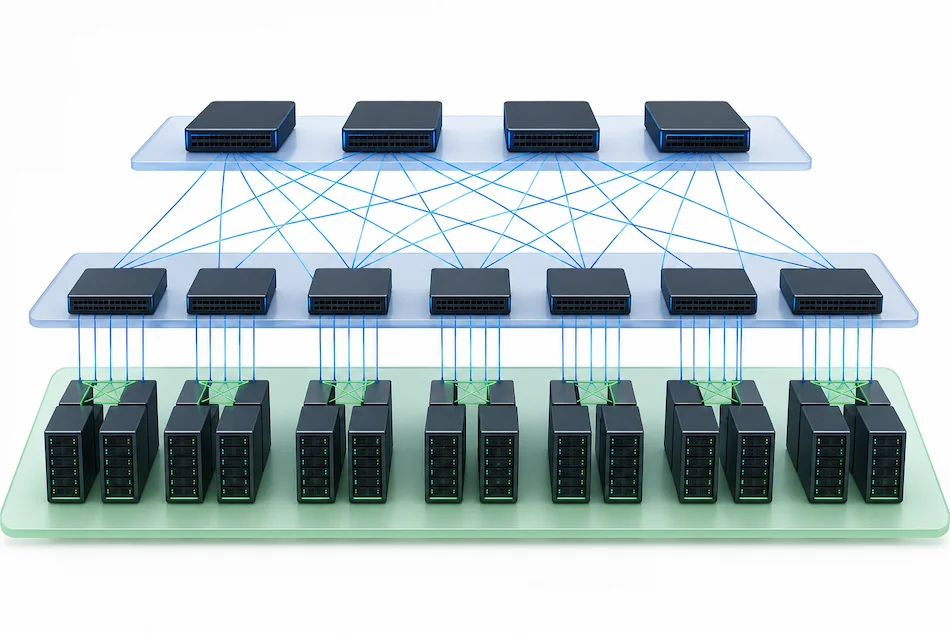
To address these challenges, modern AI data center networking increasingly relies on technologies such as RDMA (Remote Direct Memory Access), lossless Ethernet, and scalable leaf-spine architectures. These technologies help reduce bottlenecks while improving throughput for AI training and inference.
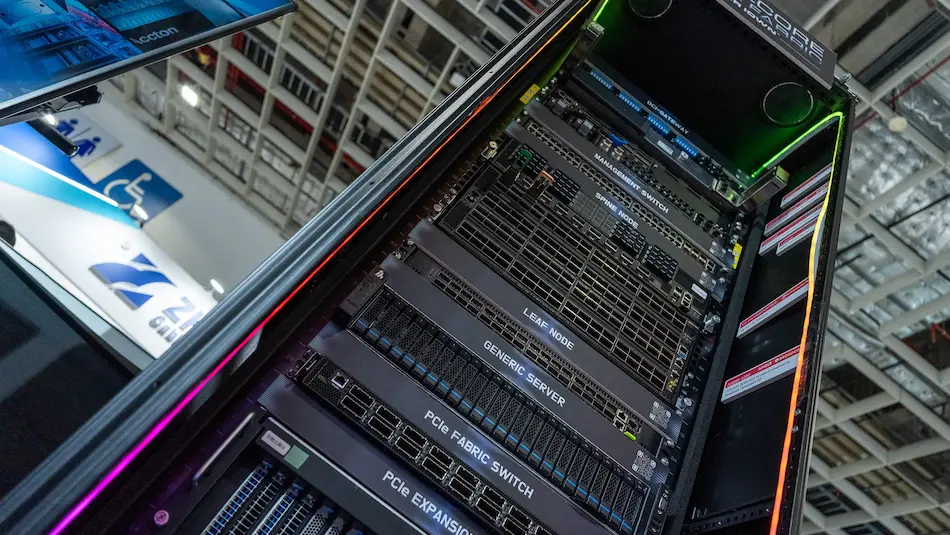
Many organizations are also adopting open networking for AI through disaggregated AI infrastructure, separating hardware and software layers to improve scalability, flexibility, and cost efficiency while reducing vendor lock-in.
Core Concepts
Explore the six core concepts shaping modern AI networking—from GPU cluster communication and Ethernet AI fabrics to open, disaggregated infrastructure.
Ethernet vs InfiniBand
The debate around Ethernet vs InfiniBand for AI networking has become increasingly important as organizations scale large AI clusters. Both technologies can support the low latency and high throughput required for modern GPU cluster networking, but they differ in cost, flexibility, and ecosystem openness. InfiniBand has long been favored for ultra-low-latency HPC environments, while advances in lossless Ethernet, RoCE, and congestion management are rapidly improving the performance of modern Ethernet AI fabrics. For organizations building scalable AI data center networking infrastructure, the decision often comes down to balancing raw performance with cost efficiency, operational simplicity, and long-term flexibility.
| Feature | Ethernet + RoCE | InfiniBand |
|---|---|---|
| Cost | Lower | Higher |
| Vendor lock-in | Low | High |
| Ecosystem | Broad | Specialized |
| AI performance | High | Very high |
For deeper technical insight into RoCE, PFC, and ECN 及 total cost of ownership, explore our technical resources.
Open Networking for AI
As AI infrastructure scales, many organizations are rethinking proprietary networking models that rely on tightly integrated hardware and software. Open networking for AI offers a more flexible, cost-efficient approach by separating the network operating system from the underlying hardware.
At the core of this approach is network disaggregation, which allows operators to choose best-of-breed hardware and software independently. This enables more scalable GPU cluster networking while reducing dependence on a single vendor ecosystem.
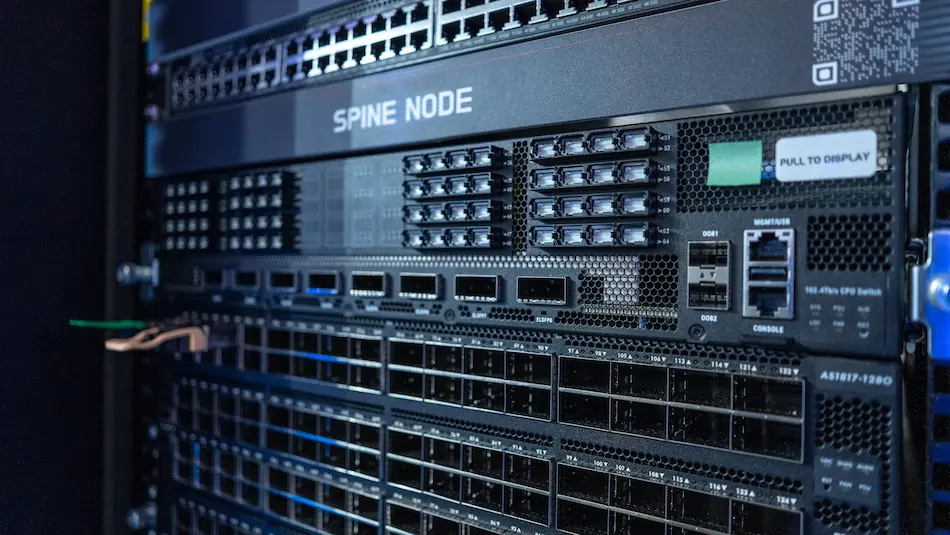
Whitebox AI networking is a key enabler of this model. Built on standardized hardware and powered by merchant silicon AI switches, whitebox platforms deliver hyperscale-class performance without the premium cost of proprietary systems.
Operating systems such as SONiC enable highly scalable, programmable networking through automation, telemetry, and modern APIs. A well-designed SONiC AI fabric helps simplify operations while supporting large-scale AI workloads.
The result is lower total cost of ownership (TCO) across the network lifecycle through reduced hardware premiums, improved operational efficiency, and minimized vendor lock-in.
Traditional vs Open AI Networking
| Traditional AI Networking | Open AI Networking |
|---|---|
| Proprietary stack | Disaggregated stack |
| Closed NOS | SONiC |
| Vendor lock-in | Multi-vendor flexibility |
| Higher TCO | 降低 TCO |
This is where Edgecore differentiates—combining high-performance open hardware, industry-leading silicon, and broad ecosystem compatibility to deliver scalable, efficient, and future-ready AI networking infrastructure. Explore real-world AI deployments to see open AI fabrics in production.
Resource Library
為什麼 SONiC 非常適合 AI 資料中心? | Explores how SONiC enables scalable, open, and flexible networking architectures optimized for high-performance AI and cloud data center environments.
從基礎元件到完整方案:一站式企業 AI 開放基礎架構解決方案 | Breaks down how modular, open networking components come together to deliver a complete, turnkey infrastructure for enterprise AI deployments.
以規模驅動 AI:PFC 與 ECN 在大型 GPU 部署中不可或缺的資料中心橋接技術 | Explains how PFC and ECN technologies enable lossless Ethernet performance critical for large-scale GPU clusters and AI training workloads.
Broadcom Tomahawk 6:為最新一代人工智慧和超大規模網路提供支持 | Covers how Broadcom’s Tomahawk 6 switching architecture supports next-generation 400G/800G AI and hyperscale data center networks.
立即部署的五個殺手級 AI 應用理由! | Highlights key real-world AI application drivers that are accelerating demand for scalable, high-performance data center networking.
人工智慧/機器學習白皮書 | Best practices for networking infrastructure supporting AI and machine learning workloads.
Edgecore Open Fabric White Paper | Insights into scalable AI networking architectures and deployment considerations.
Total Cost of Ownership (TCO) | Analysis of infrastructure efficiency, scalability, and cost optimization for modern AI environments.
建構人工智慧優化的資料中心架構:解耦與高效能網路的融合 | Learn how disaggregated infrastructure and open networking enable scalable, high-performance AI fabrics optimized for modern GPU workloads.
利用博通的 Edgecore 開放式網路交換器和企業級 SONiC 為企業解決方案提供強大支持 | Discover how Edgecore and Enterprise SONiC combine open hardware and software to build scalable, production-ready AI networks.
建構人工智慧的完美架構:DriveNets 調度乙太網 | Explore how Scheduled Ethernet improves congestion management, latency, and throughput for large-scale AI clusters.
可程式解耦網路運行環境 | See how programmable, disaggregated networking delivers greater automation, flexibility, and control for modern AI infrastructure.
一套 NOS,駕馭 600 種網路,徹底擺脫廠商綁定 | Learn how a unified network operating system simplifies operations while reducing vendor lock-in across large-scale deployments.
Broadcom SONiC X Edgecore 資料中心交換器 | Demonstrates how Edgecore and Broadcom SONiC deliver scalable, high-performance switching for modern data center fabrics.
透過鈺登科技的SONiC社群發行版解鎖創新 | Shows how Edgecore’s Community SONiC distribution enables flexible, open, and scalable network deployments for modern data center environments.
IPNexia攜手Edgecore Networks和Deca Consulting為資料中心提供支持 | Learn how IPNexia built a high-performance, scalable data center network using Edgecore open networking solutions.
Edgecore Networks:率先採用 Submer、Stellium 資料中心和 Circle B 進行浸入式冷卻 | Explore how immersion cooling and open networking help support dense, power-efficient AI infrastructure at scale.
LINX 選擇 Edgecore 網路和 IP Infusion 進行 LON2 LAN 刷新 | See how LINX modernized network infrastructure using disaggregated networking for greater scalability and operational flexibility.
Edgecore在NCTU部署基於OpenFlow的全球SDN | Highlights how software-defined networking enabled centralized control and greater network programmability at scale.