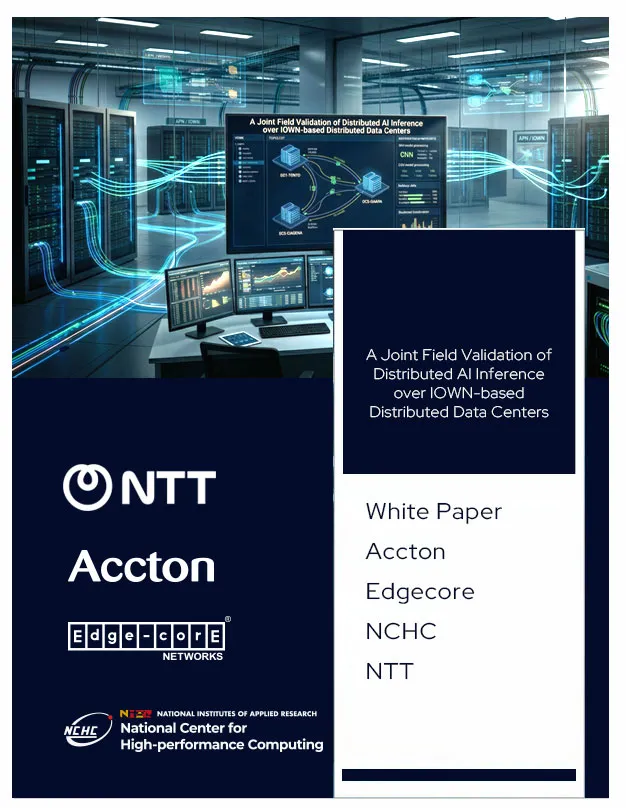
A evolução rumo a uma infraestrutura de IA centrada em redes
A rápida expansão de aplicações baseadas em IA, como serviços para cidades inteligentes, automação industrial e análise de imagens em tempo real, exige cada vez mais processamento de latência ultrabaixa, utilização escalável de GPUs e conectividade de alta largura de banda.. As arquiteturas convencionais de data centers centralizados enfrentam cada vez mais limitações para atender a esses requisitos emergentes.. Para superar esses desafios, um estudo colaborativo de validação de campo foi iniciado por Accton, Edgecore, NCHC, NIAR e NTT. Este estudo demonstrou com sucesso a viabilidade da inferência de IA distribuída em uma Rede Totalmente Fotônica (APN) baseada em IOWN, conectando centros de dados em Taiwan e no Japão..
Um ecossistema colaborativo transfronteiriço Este projeto multidomínio foi executado de forma singular, como uma implementação prática em campo, em vez de uma simulação controlada em laboratório.. Cada parceiro contribuiu com conhecimento especializado para o ecossistema:
-
A NTT forneceu a arquitetura IOWN, as tecnologias de conectividade APN e o controle de orquestração..
-
A Accton contribuiu com a arquitetura de infraestrutura de IA e plataformas de hardware desagregadas..
-
A Edgecore forneceu plataformas de integração de sistemas, redes ópticas e gerenciamento operacional..
-
O NCHC e o NIAR forneceram os ambientes de computação distribuída em GPUs, as instalações de validação e as plataformas de execução de cargas de trabalho de IA.. Trabalhando em conjunto, eles validaram com sucesso uma arquitetura transfronteiriça envolvendo redes, transporte óptico, infraestrutura de IA e integração operacional..
Estrutura de Validação e Resultados A parceria utilizou uma demonstração de Monitoramento Inteligente de Tráfego como estrutura prática de validação.. O objetivo era avaliar se os serviços de IA poderiam ser executados dinamicamente em recursos computacionais geograficamente distribuídos.. A validação em campo confirmou que a inferência de IA distribuída pode ser realizada em locais geograficamente separados com latência estável, significativamente auxiliada pela conectividade baseada em APN.. Além disso, o projeto comprovou que os recursos de GPU distribuídos podem ser coordenados independentemente da localização física.. Ao integrar a orquestração de interconexão de data centers (DCI) e tecnologias de comutação de comprimento de onda óptica, a infraestrutura suportou engenharia de tráfego altamente flexível..
A solução de rack de tecido aberto e perspectivas futuras Com base nesses resultados positivos, as organizações avaliaram um modelo implantável conhecido como Solução de Rack de Tecido Aberto.. Essa arquitetura modular e desagregada integra servidores de aplicativos, conectividade APN, gateways DCI e plataformas de rede abertas para oferecer suporte a serviços de IA de última geração centrados em rede.. A mudança arquitetônica fundamental proposta por este documento técnico é a transformação da computação centrada em dispositivos para uma infraestrutura de IA distribuída centrada em redes..
Em conclusão, esta validação conjunta em campo demonstra que a colaboração multipartidária no ecossistema é vital para acelerar a evolução de uma infraestrutura de IA implantável globalmente.. Ao aproveitar a IOWN APN e o hardware desagregado, a indústria de tecnologia pode fazer a transição da computação em silos para uma estrutura de IA altamente eficiente e preparada para o futuro..
- Download
- Download 1224
- Tamanho do Arquivo 1,24 MB