World's fastest AI switches powered by Broadcom Tomahawk® 6 & 5. Ultra-deep shared buffer with DLB/GLB for zero-packet-drop LLM training at scale.
1.6T Throughput102.4 Tbps
800G Throughput51.2 Tbps
EXPLORE→
LEAF ACCESS
Leaf Node
DCS520 · 25.6T · 64× 400G
25.6T ToR switching powered by Broadcom Tomahawk 4. 64× 400G QSFP56-DD ports with ONIE for open NOS deployment including SONiC.
Ports64× 400G QSFP56-DD
Throughput25.6 Tbps
EXPLORE→
02
Composable Compute
Disaggregated accelerator chassis and memory fabric for AI workloads.
COMPOSABLE COMPUTE
PCIe Chassis
Accelerator Expansion Fabric
PCIe Gen 5/6-ready chassis for composable GPU/ASIC attachment with hot-swap and OOB management.
PCIe Gen5.0 / 6.0 Ready
BW / Slot256 GB/s
EXPLORE→
MEMORY FABRIC
CXL Chassis
Disaggregated Memory Pooling
CXL 3.1-native memory pooling. 4 hosts + 2 CEC, with 20 CXL cards total supporting up to 20 TB shared memory pool.
ProtocolCXL 3.1
Shared MemUp to 20 TB
EXPLORE→
03
Rack Infrastructure
Liquid cooling integration for high-density AI pod deployment.
THERMAL INFRASTRUCTURE
Liquid Cooling CDU
High-Density Heat Exchange
100–200 kW in-rack CDU with N+1 redundancy, real-time flow telemetry, BMS/SDN integration. Up to 20% PUE gain.
Capacity100–200 kW
RedundancyN+1 Pump
MonitoringFlow + Leak
PUE GainUp to −20%
LIQUID COOLING STATUS
SYSTEM ACTIVE
All zones cooling · flow nominal
COOLANT TEMP
18.0°C
FLOW RATE
0 L/m
VIEW DETAILS→
COOLANT
18.0°C
FLOW
0 L/m
PUE GAIN
−20%
STATUS
ACTIVE
EDGECORE × ACCTON · IOWN GLOBAL FORUM MEMBER
Open Fabric, Open APN — How Edgecore is Building for IOWN®
Why photons beat electrons — and how we're building the hardware to prove it
THE PROBLEM WITH ELECTRONS
Your Network Is Quietly Sabotaging Your GPUs
Here's a number that should keep infrastructure architects up at night: in a conventional AI training cluster, up to 40% of end-to-end latency comes not from compute, but from the network — specifically from the relentless cycle of converting light to electricity and back again at every switching hop. It's called O-E-O (Optical-Electrical-Optical) conversion, and it is the silent tax on every all-reduce operation your cluster ever runs.
Every time a signal traverses a conventional switch, it hits a SerDes (Serializer-Deserializer), gets re-timed, re-amplified, and error-corrected before being converted back to photons. Each conversion adds roughly 100–200 ns of latency and burns 1–5 W per port. At the scale of a 1,000-GPU training job — with thousands of all-reduce synchronizations per second across hundreds of nodes — those nanoseconds and watts compound into something that actively bottlenecks the silicon you paid seven figures to deploy.
The IOWN Global Forum — founded in 2020 and now comprising over 170 member organizations including NTT, Intel, Sony, Ericsson, KDDI, Nokia, SKTelecom, Fujitsu, and Accton — was built on one architectural conviction: eliminate O-E-O entirely. Keep the signal in the optical domain, end to end. That conviction has a name: the All-Photonics Network.
"IOWN is the next-generation information and communications infrastructure. We are working to realize a highly energy-efficient infrastructure by innovating the system by delivering light to the inside of computers." — Yoshitsugu Shimazu, VP of Innovative Technology Office, NTT
100×
LOWER POWER TARGET
125×
HIGHER CAPACITY TARGET
200×
LOWER LATENCY TARGET
170+
IOWN FORUM MEMBERS
WHAT IS IOWN, EXACTLY?
Light-Speed Networking, Taken Literally
IOWN — Innovative Optical and Wireless Network — is a photonics-based infrastructure paradigm with targets the IOWN Global Forum describes as 100× lower power consumption and 200× lower latency versus conventional networks. The core enabling technology is the Open All-Photonics Network (Open APN), whose Release 1 architecture was published in 2022.
The APN is a wavelength-switching-based, connection-oriented network. Instead of packet-switching through SerDes-laden ASICs, it dynamically creates dedicated optical wavelength paths between endpoints. The architecture defines three functional components: APN-T (Transceiver — the user-owned optical endpoint), APN-G (Gate — the optical switching node), and APN-I (Interchange — inter-domain connection). Together they enable tens-to-hundreds of Gbps transfer at sub-millisecond latency, without a single O-E-O conversion in the data path.
One underappreciated breakthrough is miniaturization. Early-generation coherent transceivers were rack-scale systems. Today they fit in a module the size of a finger — which means enterprises can now build their own optical backbone networks rather than depending entirely on carrier infrastructure. IOWN is not just a telco technology anymore. It's enterprise-grade.
Fig. 1 — Edgecore Open Fabric APN topology: 7-wavelength DWDM links connect DCI Gateway → Spine → Leaf → GPU Pod with no electrical conversion at any hop
IOWN IN THE WILD
From Proof-of-Concept to Production: It's Already Happening
IOWN isn't a whitepaper technology waiting for 2030. NTT's Open APN Proof-of-Concept — winner of the IOWN Global Forum's 2024 PoC of the Year award — demonstrated APN-G optical switching in a live metro area network, validating path setup times, power consumption benchmarks, and real-time telemetry performance against spec. Commercial deployments were anticipated as early as 2025.
Sony and its partners (Fujitsu, Sumitomo Electric, Keysight Technologies, NEC) won the 2025 Implementation of the Year for a reference implementation that achieved motion-to-photon latency as low as 6.7 milliseconds at 360Hz for cloud-rendered interactive entertainment.
The IOWN Global Forum is actively targeting three priority deployment areas: high-performance financial services transaction infrastructure, media transport for broadcast (edge to studio), and AI-based product development for industries like automotive and healthcare requiring GPU infrastructure.
THE EDGECORE OPEN FABRIC STACK
Six Products. One Coherent Vision. Zero Compromises.
Edgecore Open Fabric isn't a single SKU — it's a full-stack open infrastructure platform, layer by layer, for the IOWN APN era. Launched in May 2025, it combines Edgecore's open networking heritage (an early OCP contributor since 2014, SONiC pioneer since 2018) with composable compute and IOWN-certified optical transport into a single lifecycle-managed solution.
SEE THE STACK
IOWN DCI Gateway — IRX3032 + AMX3200
OWS + Coherent Transponder / Muxponder
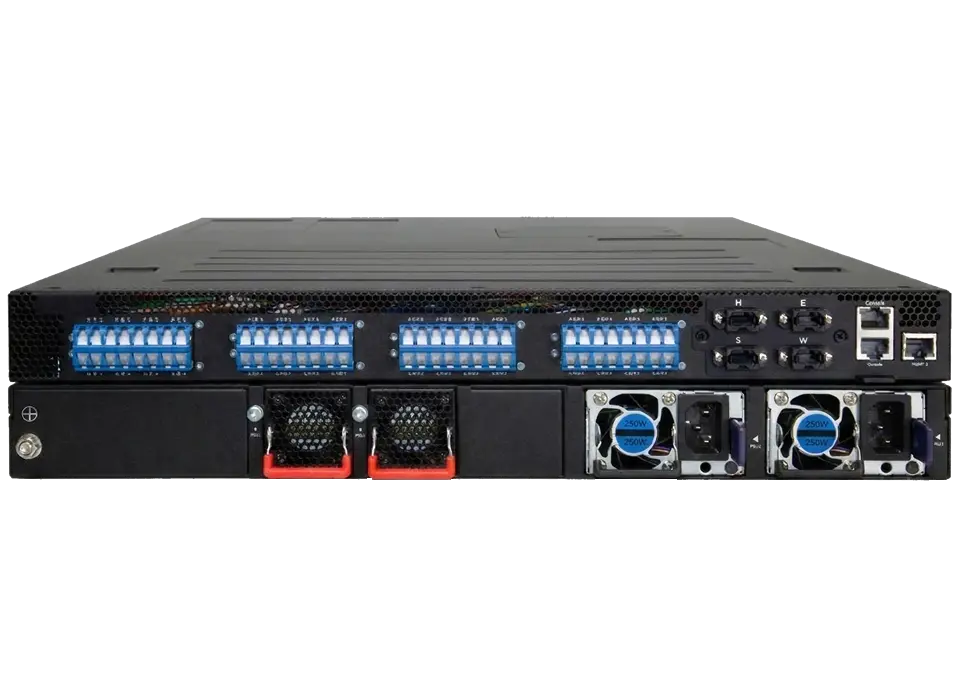
The IRX3032 is a 1RU LCoS-based optical wavelength switch with 32 WDM channels, delivering 160ns demonstrated end-to-end latency at just 159W — 40–60% lower power than conventional packet switches. It operates as an APN-G/APN-I node with gridless wavelength flexibility and supports up to 25.6T optical bandwidth. The AMX3200 is a 3.2T coherent transponder/muxponder with dual SLED design (1.6T per SLED), supporting 100–400G line rates across DP-16QAM, DP-8QAM, DP-QPSK and dQPSK modulation — compliant with OIF400ZR, OpenZR+ and OpenROADM, with reach up to 2000 km and PTP IEEE 1588v2 Class C.
Spine Node — AIS1600-64O / AIS800-64O
102.4T / 51.2T · Broadcom Tomahawk® 6 & 5
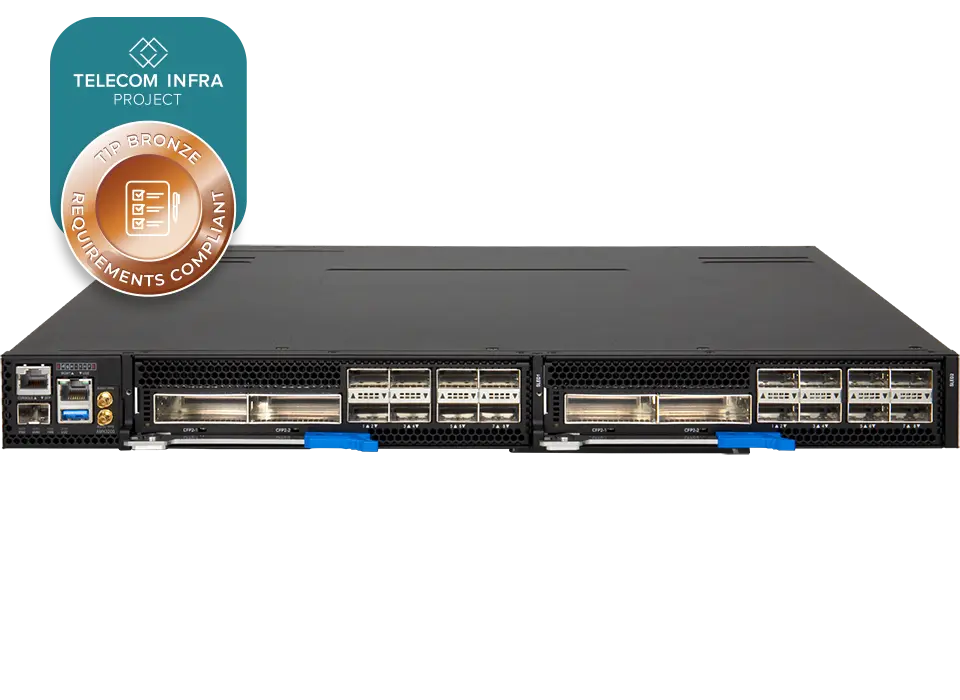
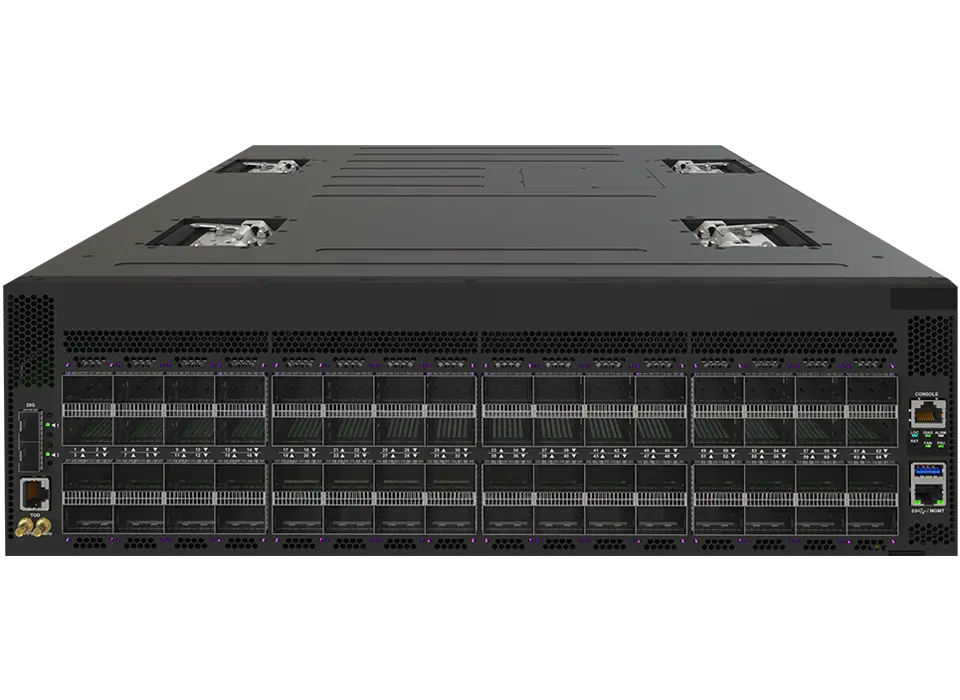
The AIS1600-64O delivers 102.4 Tbps across 64× 1.6T OSFP ports, powered by Broadcom's 3nm Tomahawk® 6 with a 267MB fully-shared buffer and up to 512 logical ports — purpose-built for hyperscale AI/ML training fabrics at sub-microsecond latency. The AIS800-64O brings 51.2 Tbps via 64× 800G OSFP ports on Tomahawk® 5 (5nm), with up to 320 logical ports, 30W per-port transceiver power, and full RoCEv2/SRv6 support. Both feature Cognitive/Adaptive routing with DLB and GLB to minimize Job Completion Time.
Leaf Node — DCS520 (AS9736-64D)
25.6T · 64× 400G QSFP56-DD · Tomahawk 4
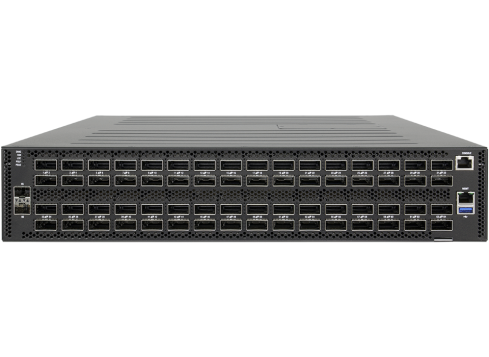
The DCS520 delivers 25.6T of switching capacity across 64× 400G QSFP56-DD ports powered by Broadcom Tomahawk 4. Each port supports 400G, 100G, 40G, or breakout modes down to 4×10G. Ships with ONIE for automated SONiC or OcNOS deployment — nothing proprietary, nothing locked.
PCIe Chassis
10× FHDW · Gen 5/6 · 256 GB/s Per Slot
Ten hot-swap full-height, double-width slots at 256 GB/s each — PCIe Gen 6 ready for next-generation accelerators. OOB management via IPMI/Redfish.
CXL Chassis
CXL 3.1 · 4 Host + 2 CEC · Up to 20 TB
CXL 3.1-native memory disaggregation with a 4 host + 2 CEC configuration. Each CEC houses 10 CXL cards (128GB × 8 = 1 TB per card), 20 cards total — delivering up to 20 TB of shared memory with sub-100 ns fabric hop. Powered by partnership with Liqid for software-defined composable compute.
Liquid Cooling CDU
100–200 kW · N+1 · In-Rack
100–200 kW in-rack CDU with N+1 pump redundancy, real-time flow and leak telemetry, and BMS/SDN integration. Supports in-rack deployment topology, scaling up to 10 racks. Field deployments show PUE improvements of up to 20%.
WHY OPEN MATTERS
The Hidden Cost of Photonic Lock-In
Proprietary photonic stacks exist. They work. They also command a significant premium per port, tie your upgrade cycle to a single vendor's roadmap, and make multi-vendor interoperability a quarterly contract negotiation. The IOWN Global Forum's Open APN specification was explicitly designed to prevent this — it defines open interfaces at the APN-T, APN-G, and APN-I layers so that any compliant equipment from any of the Forum's 170+ members can interoperate.
Accton and Edgecore have been OCP contributors since 2014 and SONiC pioneers since 2018. Edgecore Open Fabric is built on OCP hardware standards, SONiC-compatible networking software, and open APIs throughout.
IOWN USE CASES IN PRODUCTION
What Can You Actually Do With This?
REMOTE GPU OVER APN
Run centralized GPU compute while distributed sites access it over the APN. With zero O-E-O conversion and up to 2000 km reach, a remote GPU pod feels local to any connected site.
HIGH-FREQUENCY FINANCIAL INFRASTRUCTURE
APN's deterministic, sub-millisecond latency provides an infrastructure edge for transaction databases and market data distribution.
DISTRIBUTED AI TRAINING FABRIC
LLM training jobs spanning multiple datacenters benefit from APN's zero-O-E-O inter-site links at line speed.